Locating the Art of Orkney’s Grasses
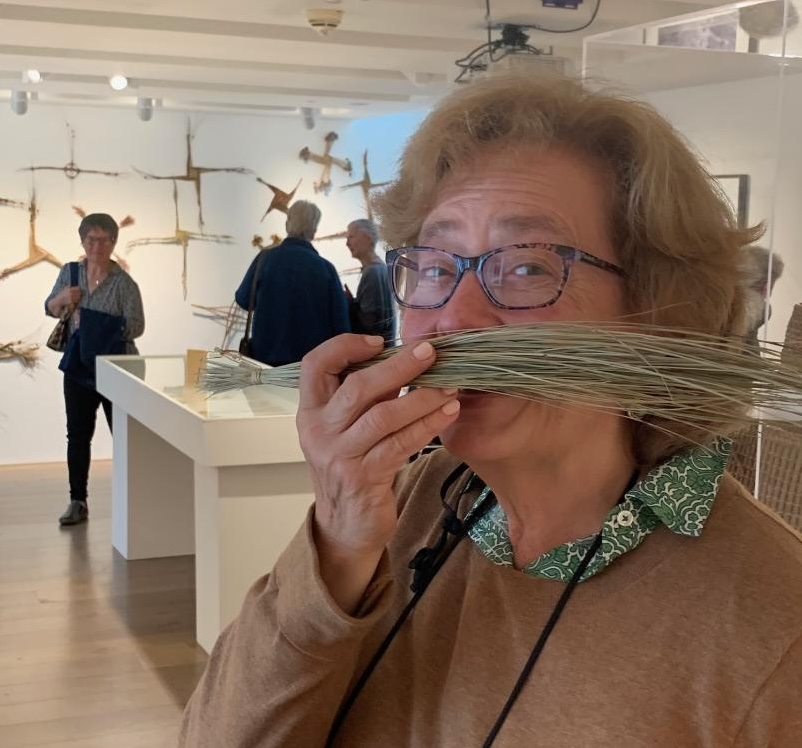
Dr. Laura Severin recently returned from a research trip to Orkney and offered this account of the experience.
“The grass is a warm freend”
“This past September I journeyed to the Orkney Islands, north of the mainland of Scotland, to view Scottish poet Valerie Gillies and Scottish photographer Rebecca Marr’s art installation Buss o Gress/Tuft of Grass. Part of the 2025 International Orkney Science Festival, it was on display at the Pier Arts Centre in Stromness, Orkney. Such journeys are not unusual for me, since my research often focuses on public art, particularly collaborations between women artists, and how these pieces impact contemporary audiences. While in Stromness, I viewed the installation, attended three presentations led by Gillies and Marr, and interviewed them as part of my research.
The relatively small gallery of the installation contained many pieces, not only Gillies’s poems and Marr’s photographs but also works by sculptor Frances Pelly and textile artist Joanne B Kaar, alongside artefacts from the Stromness Museum and Orkney Museums. Marr described the exhibit as “busy, like a meadow.” And like a meadow, the installation invoked all the senses—sight, sound, touch, taste, and smell—in order to close the distance between the natural and the human, with the goal of providing a healing experience for the viewer and teaching the importance of grasses in sustaining human life.
Gillies’s poems, many in Scots (as above), were displayed in field notebooks, written long hand in pencil to evoke the physical presence of the poet. Viewers could often be heard reading the poems aloud. Marr interspersed photographs with photograms made by placing the grass plant on light-sensitive paper. Throughout the exhibit, Marr and Gillies left behind these traces of their touch. The works by Frances Pelly, an impressive wall of St. Brigid’s crosses (three-or-four armed crosses traditionally made of rushes), and Joanne B Kaar, grass sock creations inspired by “Straw Angus” (the WWII psychiatric patient who wove beautiful and strange pieces out of grass), were included to provide texture and reinforce the healing messages of the installation. The grasses themselves surfaced in renderings by agronomist Emil Korsmo and botanist Magnus Spence, as well as in the vases of hauntingly sweet-smelling holy grass and soft-to the-touch bog grass artfully displayed in one of the windows, breaking down distinctions between art and science. As Marr explained, “You are constantly being asked to engage with the show. It would be very difficult to go to the show and submissively receive it.”
Now that I’m back in Raleigh, I will be examining how the Buss o Gress installation fits into the two artists’ six-year When the Grass Dances project, which includes a website, a kist or decorative chest containing poems and photographs, a film, the installation, and now the book, When the Grass Dances, published by Luath Press in 2025. All the pieces can be viewed here: https://whenthegrassdances.art/. I am currently working on a conference proposal based on the project that looks at how feminist sensory studies can be used to understand the larger work’s health and environmental objectives.”


